Categories. Powered by Blogger.
RSS

Beijing Facts and District Guides

Beijing, located in the northwestern end of the North China Plains, is the capital of the People's Republic of China. A municipal city directly under the jurisdiction of the Central Government, Beijing is the national political, cultural and foreign exchange center. Area: 16,800 square kilometers. Population: 13.82 million.

Because of its role in the life and growth of China, there is an unequalled wealth available for travelers to discover as you explore Beijing's ancient past and enjoy its exciting 21st Century world. In 2008 when Beijing hosts the Olympic Games, Beijing will show the world something so special that everyone will be awestruck by Beijing's latest accomplishments combined with its ancient history.

Beijing City Facts 
Population 13 Million
County Level Divisions 18
Township Divisions 273
Country Code 86
City Code 10
Postal Code 100000 - 102600
Ethnicities Han - 96%
                  Manchu - 2%
                  Hui - 2%
                  Mongolian - 0.3%
Municipality 16,808 km2 (6,489.6 square miles)
Elevation 43.5 meters (142.7 feet)
Municipality 14,930,000 (26th)
Density 888/km2 (2,299.9/square miles)
Urban Approx. 7.5 million
City Tree Chinese arborvitae, Pagoda tree
City Flower Chrysanthemum, Chinese rose
Voltage Used 220 ¨C 240 watt

Beijing District Guide
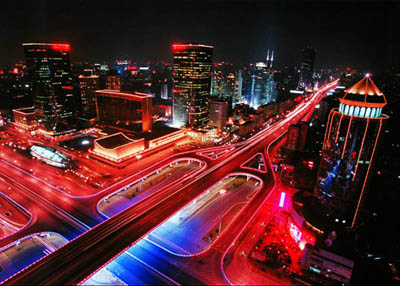
There are 10 districts and eight counties in the Beijing municipality proper. Within each district are distinctive "areas". Most areas of interest are the downtown area located in eastern Chaoyang and central Dongcheng district. Districts/areas highlights.


Chaoyang District
Probably the most commercial and residential area in Beijing, Chaoyang offers a lot to see for the visitor. Chaoyang Park, Sanlitun, and the Jianguomen/Ritan area (business/embassy district) are found within this district.

Chaoyang Park
This is a beautiful park, neighbored by many popular bars, pubs, restaurants, shops and high-rises. And if you are looking to buy western food ingredients, Jenny Lous is the place to go.

Chongwen District
Located south of the city, this is an established area with boutiques, and shops selling everything from eyeglasses to sporting goods. Though not as flashy as the other areas, Chongwen is still worth a visit since, attractions like the Temple of Heaven are located there. There are many traditional Chinese handicrafts and other unique knick-knacks in this area and bargaining is accepted.

Dongcheng District
This district is tourist central, boasting Tiananmen Square, The Forbidden City, and Mao's Mausoleum. Major hotels, such as the Beijing Hotel and the Grand Hyatt, surround this area. Serious shopping can be done in the neighboring Wangfujing area.

Fengtai District
Located southwest of Beijing, this is mainly an industrial area with several cultural and historical sites worth visiting such as, the China Space Museum, Fengtai Park, and Marco Polo Bridge.

Haidian District
Known also as the school district, this northwestern part of the city hosts Beijing and Tsinghua University, China's equivalent to Harvard and MIT. Because of the young student population, this area has a reputation for being hip, artsy and on the cutting edge. Also designated as a high-tech zone, this is where the aspiring computer and internet start-ups are found. There are plenty of good restaurants and casual bars catered to the student crowd.

Jianguomenwai/Ritan
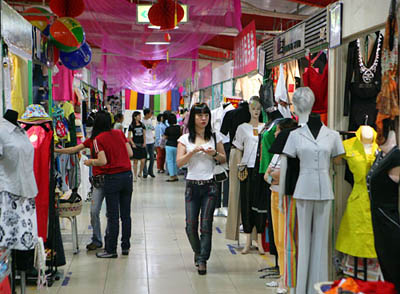
A wide mix of international faces can be seen here: tourists, businesspeople and local Chinese. The main street, Jianguomenwai, is a mad hustle of people, cars, and rickshaws, as well as vendors selling everything from CDs to high-end clothing. Major hotels and office buildings are found here, including the massive China World Hotel. Tourists can try their hand at bargaining at the Silk Market. Just a few blocks away, one can find peace and quiet in Ritan Park, the graceful tree-lined streets of the embassy area.

Sanlitun
Sanlitun is a loosely designated area of bars and pubs with Sanlitun Bar Street at its heart. Sanlitun Bar Street is Beijing's premier people-watching spot. On a warm sunny day, people sit at the sidewalk patios and
chill out over drinks. There are also numerous funky shops selling everything from clothing and framed prints to Tibetan handcrafts. At night, the decadent side of Sanlitun is revealed and the clubs truly come to life.

Wangfujing
Located in the Dongcheng district, this is Beijing's main shopping street and a showcase of Beijing's economic progress to modernity. It is always crowded with shoppers and tourists alike. Partially closed to cars, pedestrians have free reign over the wide sprawling streets. Stop off at the Beijing Foreign Language Bookstore or go shopping at Beijing's mammouth-like shopping mall in Sun Dong An Plaza. Give your taste buds a surprise by dining on deep fried scorpion or any of the other culinary delights at the Wangfujing Night Market. If the idea of chomping on insects is not terribly attractive, upscale dining is available at the several four and five star hotels in the area.

Xidan/Xianwu
Like Wangfujing, this area is also known for shopping. But unlike Wangfujing, Xidan is a place where many local Chinese shops are located. So generally speaking, shoppers will find better prices here. Browse in the small shops and stalls for bargains on clothing, shoes and CDs. Several shopping centers such as Parksons and Xidan Department Store can be found here.

Beijing Safety
Given its size, Beijing is one of the safest cities in the world. There are relatively low reports of crime and theft. Still, that doesn't mean you should take the usual precautions. It is suggested that you keep valuables in a safe place, put your large sums of money in banks, keep your doors locked at night and do not walk alone at night.

Beijing Sanitation
With the entry of China into WTO and the upcoming Olympics in 2008, Beijing is quickly becoming a world-class city. Sanitation in Beijing is not what it used to mean to the foreigner, that of stinky toilets and litter all over the place. Still, there are squatting toilets, a novelty to the uninitiated Westerner.

  • Digg
  • Del.icio.us
  • StumbleUpon
  • Reddit
  • RSS

Beijing Economy

The economy of Beijing has changed dramatically since 1949. Traditionally the city was primarily an administrative and cultural center because of its far distance from the country's key economic area, the Yangtze River valley. In the 1990s, however, the environment began to change as the private sector began to take off. Foreign investors began to understand the importance of China as a world economic power, and residents of Beijing continue to witness massive economic growth, structural expansion, and technological modernization. Entrepreneurs were quick to open bars, clubs and restaurants to accommodate the new generation of people who benefited fiscally from this expansion.

As the economy continues to boom on both the local and global levels, Beijing business is one of the hottest topics in the world. The Beijing 2008 Olympic Games have attracted both foreign and domestic travelers, giving this thriving city further exposure to the outside world. Paired with the fact that foreign trade and global economic cooperation are thriving, Beijing is one-of-a-kind business environment that offers countless opportunities.

  • Digg
  • Del.icio.us
  • StumbleUpon
  • Reddit
  • RSS

Beijing Environment


As the cultural and political center for the country, Beijing is very safe for foreigners. There is an abundance of events always happening in the city, whether it is an important political meeting or the latest car show. Additionally, Beijing's folklore still holds forth the fascination of old-time peculiarities. A rich heritage in culture and art brought to life by burgeoning urban development has made Beijing the dream place to be for travelers from around the world.

About 95% of the Beijing people are Han Chinese, while the rest of China's 56 official ethnic minorities are scattered about the city.

  • Digg
  • Del.icio.us
  • StumbleUpon
  • Reddit
  • RSS

Beijing Geography


Beijing is located at the northern tip of North China Plain, the city lies at approximately the same latitude as Philadelphia in the U.S. and Madrid, Spain. Mountainous along the north and west, and flat in the southeast, Beijing has a total area of 16,800 square kilometers, roughly the size of Belgium.

The city is surrounded on the west, north and east by the Yanshan Mountains. The small alluvial plain of the Yongding River lies to its southeast. Beijing faces the Bohai Sea, which is also called the Beijing Bay. The city is 39% flat land and 61% mountainous area. The highest region located in the western corner of Beijing stands at 2303 meters, while the lowest point found in the southern extremity rests at 44 meters above sea level. The city limits extend to about 80 km and consists of 18 districts and counties with a population of over 13 million people.

Beijing's land is beautified by green trees and lots of well-manicured lawns, and cultured with former imperial mansions , such as the Forbidden City, the Summer Palace and other old buildings, religious shrines and amazing old and modern structures.

  • Digg
  • Del.icio.us
  • StumbleUpon
  • Reddit
  • RSS

Beijing Through Time

Capital of China and home to more than 14 million people, Beijing has more to see than you could get through in a lifetime. Beijingers know that they live in the cultural, political and psychological center of China. Throughout the land, people chat in Putonghua, based on the Beijing dialect and follow the orders of the Beijing based Central Government. The city is also the educational center of China, with many of the best universities in the country. It follows that Beijing is also where the majority of foreign students choose to live and study. And, as 2008 Olympic Games venue, there has never been a hotter time to be in Beijing.

With a state-of-the-art second terminal being built at the Capital Airport and a new network of underground stations about to be opened, Beijing is a travel hub for both international and domestic destinations. Built on a grid, it is easy to find your way around Beijing as soon as you figure out North from South. The highly developed university area is itself in the northwest. Wandering inside Beijing's second ring road area gives a totally different view. One-storey courtyards, each with a tall tree in the middle, make central Beijing pleasantly green. Surrounded on three sides by mountains, Beijing's local peaks are the site of sections of the Great Wall, a destination for all visitors to the city.

With Governmental departments and national Embassies all located in Beijing, the city is full of people getting paperwork signed for business or travel. From the World Trade Center in the Central Business District to the computer hypermarkets in Haidian, Beijing's economic life has never looked healthier or more diverse. Although more laid back that Shanghai, Beijing sees more money circulating among its cultural attractions, theatres, and art museums. Every cuisine imaginable can be tasted in Beijing, with the best version often served near the provincial representative office or national embassy.

Step into the Forbidden City for a taste of life in the court of the Emperor, or take a walk through the Emperor's personal gardens of Beihai or the Summer Palace. Less obvious than these impressive pieces of ancient urban design are the homes of famous writers and painters, famous restaurants and trading areas that make up the fabric of the past. Beijing's 20th Century history can best be told by Beijingers themselves, so put on your best local accent and head for the streets to listen to some of the best story tellers in the country.

  • Digg
  • Del.icio.us
  • StumbleUpon
  • Reddit
  • RSS

Soto Kerbau

Waktu penyebaran agama Islam di Kudus, sudah ada pengaruh agama Hindu yang kuat. Jadi buat jaga keseimbangan umat beragama, Sunan Kudus melarang umatnya nyembelih sapi, dan sebagai alternatifnya diganti dengan kerbau. Semua daging sapi yang dijual di Kudus tuh disembelihnya di luar kota, ribet amat ya. Makanya banyak banget makanan pake daging kebo di Kudus, dan rasanya malah lebih gurih daripada sapi, cuma pengaruh di warna kuahnya aja yang jadi agak kecoklatan.


Gw bisa ngerti sih kalo ada yang jijik ama daging kebo, padahal sebenernya ya namanya daging mah sama aja lah. Klo gw uda terbiasa makan jadi uda ga brasa apa-apa. Malah klo di Jakarta gw suka kangen nyari, tapi ga ada yang jual. Di Vietnam yang orangnya omnivora banget, daging kebo ni dianggep beracun, jadi warga sana jangan harap mau makan daging kebo. Look at me! Gw fine-fine aja kok makan kebo-kebo itu wkwkwk. Hidup kebo! ~*gw ngantuk jadi sori ye klo mulai ngelantur*

Bedanya ama sapi yang berserat lembut dan kemerahan warnanya, kebo ini seratnya agak kasar dan berwarna kehitaman. Tapi ga tau knapa, penjual soto ayam pun mengakui klo daging kebo lebi gampang empuk pas dimasak. Kebonya kurang fitness kali ya @_@

Seperti Soto Kudus, disajikannya juga di mangkok kecil... eeehh tapi ada juga dink yang pke mangkok ukuran normal, tergantung belinya di mana. Isinya nasi, daging kebo, disirem pke kuah... ditaburi taoge, bawang putih dan seledri.. kadang ada yang pke kubis dan mie putih/bihun. Harganya tetep aja murah meriah, Rp. 4.000 - 5.000 /porsi. Pelengkapnya juga macem-macem, ada perkedel, krupuk rambak (dari kulit kebo), krupuk udang dan jeroan.


So far, orang dari luar kota pada pergi ke soto kebo Pak Denuh dan Karso Karsi. Dulu sih emank sotonya terkenal enak, tapi sekarang kualitas menurun. Gw selalu perginya ke Soponyono, paling enak di Kudus, bukanya cuma pagi doank.


Okay, I am off to bed now. Ciao!

  • Digg
  • Del.icio.us
  • StumbleUpon
  • Reddit
  • RSS

Lentog Kudus

Again!! Ini makanan kota gw lhoooo!!!! Hihihihi. Recently gw rada homesick, mo pulang ga mungkin karna harus ngantor... jadi ya sutra lah, gw review aja semua makanan khas Kudus.. snifff.... hiks... hiks... srooottt.. ~*lebay*

Lentog ini ga terlalu kedengeran namanya, karna ga smua orang doyan. Temen gw dari luar kota kebanyakan ga doyan sih (=.=). Orang Kudus makan lentog untuk sarapan, jadi di atas jem 12:00, jangan coba-coba nyari bakul lentog karna ga bakal ketemu deh. Di Jakarta juga ada yang jual, daerah Bintaro sektor 1, deket Hero supermarket.

Lentog Kudus terdiri dari lontong yang diiris tipis, diberi lauk sayur nangka muda (seperti gudeg), tahu tempe (tapi perbandingan jumlah tahu lebih besar), diguyur kuah santan (seperti kuah lodeh, tapi beda rasa ya), dan terakhir ditaburi brambang goreng. Biasanya disajikan di piring yang dalemnya dialasi daun pisang. Di tiap penjual lentog bakal ditemuin makanan pelengkap seperti sate telur puyuh bumbu semur, sate usus, kerupuk udang, dan bakwan sayur... ato di Jakarta biasa disebut bala-bala. Minumnya disediain teh botol dan aqua gelas.

Di desa Tanjung Karang bisa ditemuin berderet-deret penjual lentog, suasananya khas pedesaan. Tapi jalanannya lebar dan diaspal, jadi ga perlu kuatir susah parkir... jangan bayangin kaya dusun terbelakang gitu ya hehehe.

Karna yang jual banyak, uda pasti ga smuanya enak. Gw paling suka ke warungnya Pak Mitro, ini langganan gw nih. Lentognya enak dan ga hambar... rasanya juga ga manis, mala rada asin gitu, enak deh. Dulu pernah dia ga buka, gw coba ke warung sebelahnya. Halaahhh rasanya manis mampus kaya aer gula, ga enak pula (=.=").

Menurut si Mitro, klo weekend dia perlu 15 kg beras /hari untuk bikin lontong, dan 6 kg beras /hari untuk weekdays. Sekilo beras bisa jadi sekitar 30 porsi. Terakhir kali gw makan, harganya Rp. 2.000,- / porsi. Isinya sedikit, klo cowo bisa habis 3-5 porsi nih.

  • Digg
  • Del.icio.us
  • StumbleUpon
  • Reddit
  • RSS